
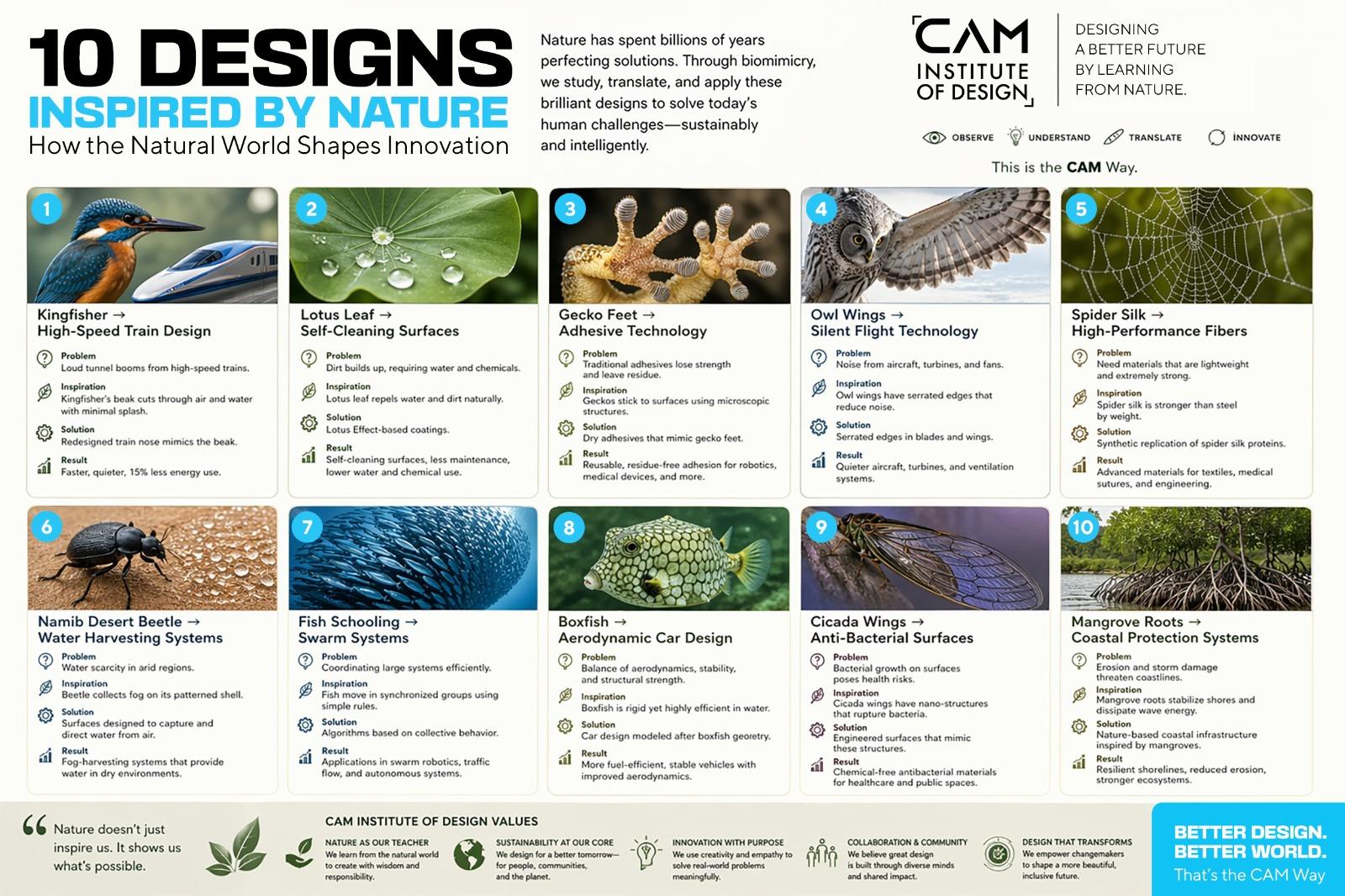
10 Designs Inspired by Nature: How the Natural World Shapes Innovation
Nature isn’t just beautiful - it’s engineered for survival. Every pattern, structure, and behavior serves a functional purpose.
The beautiful stripes of the Zebra for example, also serve as a motion dazzle which disrupts the predator’s ability to lock onto a single target. Similarly, the Bee orchid - shaped like the female Bee- attracts the male Bee to land on it for the purpose of pollination - a process essential to sustaining biodiversity and maintaining ecosystem stability.
These perfectly orchestrated designs form the foundation of Biomimicry- the practice of studying nature’s models, systems and processes to develop sustainable, efficient, and innovative solutions to human challenges. The term biomimicry was made popular by biologist Janine Benyus in her 1997 book - Biomimicry: Inspired by Nature.
From the flying machine sketchings of Leonardo Da Vinci inspired by birds to modern engineering breakthroughs, designers have always looked to nature as a blueprint. Today, biomimicry presents viable solutions to sustainability, efficiency, innovation challenges.
At design colleges like CAM Institute of Design, this insight aligns with a core principle: design education should go beyond tools, trends and aesthetics, instead it should develop systems thinkers-designers who observe, interpret, and translate the world around them into meaningful innovation.
Today, many systems are designed to replicate nature’s zero-waste and energy-efficient processes. For example, the zero emission strategies in some industries draw inspiration from natural sequestration processes found in coral reef ecosystems.
Nature also demonstrates fluid efficiency in movement. The long-haul aircraft flying in V-formations for instance, reduce drag by taking advantage of aerodynamic lift generated by leading aircraft. This results in significant fuel savings and reduced emissions. This principle is directly inspired by flocking behavior in birds.
Beyond movement, biomimicry is shaping infrastructure and materials science. Tree frog toe pads have inspired the development of high-traction tire patterns, while the Eastgate Centre uses termite-mound-inspired ventilation systems to regulate temperature using up to 90% less energy than conventional air conditioning systems.
In this article, we explore 10 real-world designs inspired by nature.
1. Kingfisher → High-Speed Train Design
The Shinkansen was redesigned after engineers studied the kingfisher.
Why?
Because the bird dives from air into water with almost no splash. That same principle was applied to train design. Result:
● Faster trains
● 15% lower energy use
● Dramatically reduced tunnel noise
2. Lotus Leaf → Self-Cleaning Surfaces
Lotus leaves don’t stay clean—they stay uncleanable. Dirt simply rolls off due to micro-structured surfaces.
This inspired coatings based on the Lotus Effect.
Result: ● Buildings that clean themselves with rainwater
● Less chemical use
● Lower maintenance costs
Real-World Example: Sto SE & Co. KGaA developed Lotusan® paint, widely used for self-cleaning building facades.
3. Gecko Feet → Adhesive Technology
Geckos don’t use adhesives. They use microscopic structures which stick to dry surfaces. NASA has adapted this for space robotics.
Result:
● Grippers that stick without wet residue
● Technology is applied in robotics and aerospace
Real-World Example: NASA developed gecko-inspired grippers for space robotics.
4. Owl Wings → Silent Flight Systems
Owls fly almost silently because of serrated wing edges that break airflow.
This principle is now used in turbine and blade design.
Siemens Gamesa applies similar designs in wind energy systems.
Result:
● Less noise pollution
● Higher aerodynamic efficiency
Real-World Example: Siemens Gamesa applies owl-wing-inspired noise reduction in turbine design.
5. Spider Silk → Next-Gen Materials
● Spider silk is stronger than steel by weight—and flexible.
● Companies are now recreating it synthetically.
● Bolt Threads is already producing bio-based silk fibers.
Result:
- Lightweight, high-strength materials for fashion, medicine, and engineering
- Real-World Example:
- Bolt Threads produces synthetic spider silk for fashion and performance materials.
- 6. Namib Desert Beetle → Water Harvesting
- In one of the driest places on Earth, the beetle survives by collecting fog on its shell. That process has inspired atmospheric water capture systems at institutions like MIT.
- Result:
- ● New methods of extracting water from air in arid regions
Real-World Example: MIT developed fog-harvesting materials inspired by beetle shell structure
7. Fish Schooling → Swarm Intelligence
Fish move in perfect coordination without a leader.
This principle is now used in AI systems, robotics, and traffic optimization. Swarm Technology develops similar coordination systems for drones.
Result:
● Smarter autonomous systems
● Efficient, decentralized decision-making
Real-World Example:
Swarm Technology develops coordination systems for drone fleets.
8. Boxfish → Aerodynamic Vehicle Design
The boxfish looks awkward - but moves with extreme efficiency in water.
Mercedes-Benz developed the Bionic Car concept inspired by boxfish structure.
9. Cicada Wings → Antibacterial Surfaces Cicada wings don’t kill bacteria chemically. They physically rupture them using nanostructures.
Researchers at RMIT University replicated this effect in engineered surfaces.
Result:
● Chemical-free antibacterial materials
● Applications in healthcare and public infrastructure
Real-World Example: Researchers at RMIT University developed bactericidal surfaces inspired by cicada wings.
10. Mangrove Roots → Coastal Protection Systems
Mangroves don’t just grow near water—they protect land from it.
Their root systems absorb wave energy and prevent erosion.
Organizations like The Nature Conservancy are applying this model in coastal design.
Result:
● Nature-based flood protection
● Stronger, more resilient shorelines
Real-World Example: The Nature Conservancy promotes mangrove-inspired coastal resilience strategies globally.
Final Thought
The future of innovation lies in our ability to integrate with systems that are time tested. Nature has spent billions of years solving the exact problems we now face- efficiency, resilience, and sustainability. The real competitive advantage lies in recognizing that the most advanced R&D lab is the natural world. Those who learn to design with it, rather than against it, will define the next era of innovation.